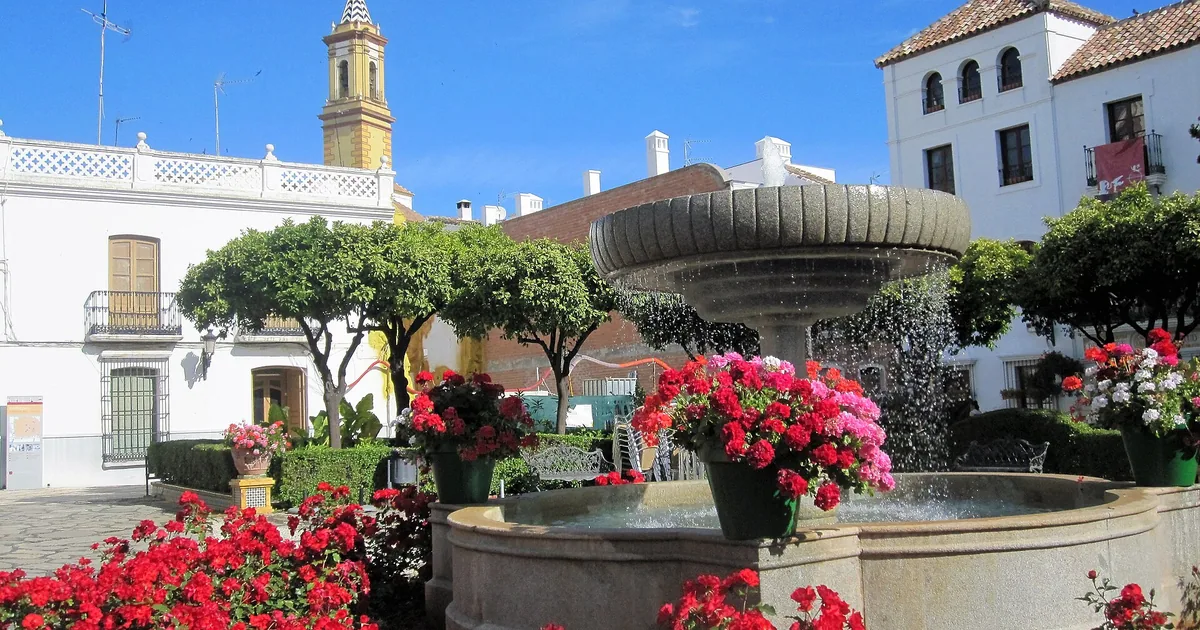
- The town's 2026 guide counts more than 130 renovated old-town streets, dressed with thousands of flower pots, each street in its own colour
- The murals route began in September 2012; it had 64 works by September 2024, when a third international competition added ten more
- The core sights (Plaza de las Flores, the 16th-century clock tower, the castle walls, the Remedios church) fit inside a two-hour loop on foot
- Estepona is about 30 km west of central Marbella, 25 to 30 minutes by car; go in the late afternoon and stay for dinner
- Estepona lies beyond the Marbella boundary, so a booking there starts at two hours, and you cover her taxi from Marbella
At six on an October evening the light in Estepona drops low enough to reach the pots on the upper walls, and Calle Real goes from white to blue, red and yellow within a few doors. The town is half an hour west of Marbella, and our clients usually reach it one of two ways: staying in Estepona itself, which our Estepona escorts page covers, or driving across for an afternoon from the Golden Mile. If the second sounds like you, our Estepona or Marbella comparison explains which town suits which kind of stay. Estepona's old town is a grid of renovated whitewashed lanes, more than 130 of them by the town's own count, each dressed in flower pots of one colour, with about 70 large murals on the facades around it, and the best of both fits a two-hour walk that starts and ends on the Plaza de las Flores.
Where Is Estepona's Old Town, and How Do You Get There From Marbella?
The old town sits a few streets back from the seafront promenade, between Calle Terraza to the north and the sea, with the Plaza de las Flores at its centre. From central Marbella it is about 30 km west on the A-7, 25 to 30 minutes by car, and around 20 to 25 from Puerto Banús. Estepona is its own municipality, not a district of Marbella.
Two Long Streets, One Square and Five Centuries
Two wider streets run roughly parallel to the coast, Calle Real and Calle Terraza, and the lanes between them make up the casco antiguo. Most of the houses date from the 18th and 19th centuries. The town itself is older: its 2026 tourist guide traces it to Estebbuna, founded under the Caliphate of Córdoba in the 10th century, taken by Henry IV of Castile in the 1450s, repopulated with 30 families when the Catholic Monarchs rebuilt the walls, and given its own charter by Philip V in 1729. Estepona had 79,621 residents on the 2025 register, according to its Wikipedia entry, but the old town is small enough to cross in ten minutes.
Taxi, Car and Where to Leave It
A taxi is the simple answer: drop-off on the edge of the old town, collection at the end of dinner, no question of who drives back on the A-7. If you drive, the underground car parks on the fringe of the old town are the sensible choice, because the lanes inside are pedestrian or one car wide and street spaces are rare. Allow longer on a summer Saturday, when the coast road slows at every roundabout. The guide to getting around Marbella without a car covers taxis and ride-hailing on this stretch, which thin out after midnight west of San Pedro.
The Flower Streets: How Estepona Became the Garden of the Costa del Sol
Since the early 2010s the council has renovated the old town street by street, repaving, whitewashing and hanging thousands of flower pots on the walls. Its 2026 guide counts more than 130 renovated streets and calls the result the Garden of the Costa del Sol. Each street keeps its own pot colour, which is how locals give directions.
One Colour per Street
The pots follow a scheme: blue on one lane, red on the next, yellow round the corner, all filled with flowers and plants. It sounds municipal on paper and looks deliberate on the ground. Photographers work the narrow lanes between Calle Real and the castle, where the walls are close enough to fill a frame. In our experience the lanes are at their best in the hour before sunset, when the white walls warm up and the shops on Calle Real are still open.
Calle Real, Calle Terraza and the Lanes Between
Calle Real is the pedestrian spine, lined with shops, cafés and the odd ceramics workshop. Calle Terraza, wider and busier, marks the inland edge and carries two of the best murals in town, so it is where the flower walk and the murals walk meet. The lanes between them are where the pots are densest and the traffic disappears. Wear flat shoes: the paving is smooth but steep in places, and a walk that looks like 500 metres on the map involves more corners than you expect.
Plaza de las Flores, the Clock Tower and the Castle Walls
Three sights carry the history. The Plaza de las Flores is the main square, with the 18th-century Casa de las Tejerinas and the tourist office. The Torre del Reloj is all that is left of a 16th-century church. A few walls of the Castillo de San Luis survive, and the Mirador del Carmen tower adds a modern viewpoint.
Plaza de las Flores and the Casa de las Tejerinas
The square is shaded by orange trees and ringed with terraces, and the town's tourist delegation sits on it, at Plaza de las Flores s/n. On one side stands the Casa de las Tejerinas, an 18th-century house now used as an exhibition space, with temporary shows and a permanent display of 20 works by the painter José Marchá. Pick up the murals map here before you start. The terraces are fine for a coffee or a glass of wine, and in the evening the square fills with locals rather than coach groups.
The Torre del Reloj and the Remedios Church
The clock tower on the Plaza del Reloj belonged to the old Iglesia de los Remedios, built in the 16th century. The church was badly damaged in the 1755 earthquake and later demolished; only the tower was kept, and in the 18th century it gained its neoclassical top. The present Iglesia de Nuestra Señora de los Remedios, a few streets away, is an 18th-century former Franciscan convent whose doorway mixes Marian, Franciscan and colonial imagery. Both take five minutes and give the walk its two fixed points.
Castillo de San Luis and the Mirador del Carmen
Of the Castillo de San Luis only walls and foundations remain, with information boards. Sources disagree on its date: the town's guide places it in the reign of Philip II, as a reinforcement of the medieval walls, while others credit the Catholic Monarchs. The Mirador del Carmen is the opposite story, a new tower by the Málaga architect Salvador Moreno Peralta, holding a vertical library, a music conservatory, an auditorium and an exhibition room, with a view over the rooftops to the sea.
How Many Murals Are on Estepona's Murals Route?
About 70. The Ruta de Murales Artísticos began in September 2012; the mayor counted 64 works in September 2024, when the third international mural competition added ten more. A few early pieces have since been painted over, so treat 70 as the working figure and use the tourist office's map, which is updated each year.
Five Murals Worth the Detour
- The Last Supper by Curro Leyton, on the side of San José church in the old town: Leonardo reworked on a whitewashed wall.
- Día de Pesca by José Fernández Ríos, in the Isabel Simón estate: about 1,000 m² across six apartment blocks, one of the largest murals in Spain.
- El Bosque de las Maravillas by Zosen and Mina Hamada, Calle Terraza 152: first prize in the 2017 competition.
- Estepona Bermeja by Ana Cecilia Salinas, in the Los Televisores estate: 30 metres high, painted in 2013.
- El vínculo que nos une by Ignacio Basave Cavanna, on the Acuarius building in Calle José Luis Díez: the 2024 winner, which took a €10,000 prize.
The Map, the Competitions and How Long It Takes
The murals are spread across the town's estates, not only the old town, so walking every one takes about three hours. Most visitors pick five or six. The council now adds works through competitions: ten murals in July 2017, another round in 2020, and in October 2024 a third edition, run with the developer AEDAS Homes, that drew 116 proposals from 13 countries for a €27,000 prize fund. The fullest independent list is on andalucia.com's murals page, which notes that the official map can lag behind the newest work.
Our Two-Hour Loop Through the Flower Streets and the Murals
Start on the Plaza de las Flores, walk Calle Real to the clock tower and the castle walls, take in the Remedios church, cross to the Calle Terraza murals and San José church, climb to the Mirador del Carmen and finish back on the square. About an hour of walking, an hour of stopping.
The Loop, Stop by Stop
| Stop | What you see | Time on foot |
|---|---|---|
| Plaza de las Flores | Orange trees, Casa de las Tejerinas, the tourist office | Start |
| Calle Real | Shops, pots, the main pedestrian line | 5 min |
| Plaza del Reloj | The 16th-century church tower | 5 min |
| Castillo de San Luis | Surviving walls and information boards | 5 min |
| Iglesia de los Remedios | 18th-century Franciscan church | 5 min |
| Calle Terraza 152 and 168 | Two 2017 competition murals | 10 min |
| San José church | Curro Leyton's Last Supper | 10 min |
| Mirador del Carmen | The tower and its view | 10 min |
| Back to the square | A drink under the orange trees | 10 min |
Times are approximate walking times between stops. Día de Pesca and Estepona Bermeja sit outside the old town, so add a taxi hop or twenty minutes on foot if you want them.
Read the Walls: The Poetry Plaques
On the same walls as the pots, look for short poems on ceramic plaques. The Ruta de la Poesía came out of the urban renewal programme of the 2010s and includes verses in several languages; one of them is in Arabic, which fits a town whose name goes back to the Moorish Estebbuna. There is no need to hunt for them: they turn up on their own along the old-town lanes. The tourist office has a leaflet if you want the full list and the authors.
When to Walk It: Light, Heat and the Town Calendar
Go in the late afternoon, from about two hours before sunset, and stay for dinner. In July and August walk before 11:00 or after 19:00. October and spring are the easy months. The town's own fixtures are Estepona Vive sus Calles in March, the feria in the first week of July and the Remedios procession on 15 August.
Morning, Afternoon or Evening?
Mornings are for photographs: empty lanes, freshly watered pots and soft light from the east. Midday in summer is the wrong time, with the white walls throwing the heat back and many shops shut from 14:00. The late afternoon is our choice for almost every client. The walk ends just as the square's terraces fill, and dinner in Estepona starts at 21:00 like anywhere else in Andalucía. If it rains, the Orchidarium on the edge of Calle Terraza is the covered alternative, and it deserves its own visit.
Fiestas, the Feria and the Sunday Port
Estepona Vive sus Calles in March brings street activities into the old town. The feria takes over the first week of July with lights and casetas, and on 15 August the Virgen de los Remedios is carried through the streets. Each makes the lanes busier and parking harder, so plan around them unless the fiesta is the point. On Sundays the crowd shifts to the market at the port, a ten-minute walk away, which leaves the old town quieter that morning.
An Estepona Afternoon With a Companion: How We Set It Up
Estepona sits beyond the Marbella boundary, which means a minimum of two hours, and her taxi from Marbella is added to the price. A walk through the old town followed by dinner fits a dinner date, which runs three hours or more. Tell us where to meet: the Plaza de las Flores, your hotel or a restaurant.
Meeting on the Square or at the Hotel
Most clients who do this are staying on the Estepona side, often at the relaunched Hacienda del Mar, ten minutes from the old town by taxi. The cleanest version: she meets you at the hotel around 18:00, you take one taxi into town, walk the loop and sit down to eat at nine. Meeting on the Plaza de las Flores works as well, because it is the obvious landmark and every driver knows it. Our dinner date companions are used to an evening that starts on foot. Clients regularly book two hours for a walk and dinner, then run out of time at the main course.
The Money, in Three Lines
Two hours, the Estepona minimum, comes to €600; a dinner date of three hours starts at €900; nothing rises at weekends or in summer, and the taxi only costs more for a remote address or a very early start. Settle with her when she arrives, in euros, by bank transfer or in crypto; there is no card machine in this business, and the 25% deposit only applies when you book days ahead. Every figure is listed in what a booking costs, how payment works and our cancellation guide, which gives dinners a free change until 24 hours before. Our Marbella escort agency takes bookings for Estepona on WhatsApp at any hour.
Frequently Asked Questions
How long does it take to walk around Estepona old town?
The old town itself takes about ten minutes to cross. A loop that takes in the Plaza de las Flores, the clock tower, the castle walls, the Remedios church and a few murals takes about two hours with stops. Seeing all of the roughly 70 murals across the town takes around three hours.
Is Estepona old town worth visiting from Marbella?
Yes, for an afternoon and dinner. It is 25 to 30 minutes from central Marbella by car, the flower-pot lanes and murals have no real equal in Marbella, and the evening is calmer. Go two hours before sunset, walk the old town, then eat in town rather than driving straight back.
Where is the best place to park in Estepona old town?
Use one of the underground car parks on the edge of the old town; the lanes inside are pedestrian or single-track and street spaces are scarce, especially on summer weekends and during the July feria. A taxi from Marbella avoids the question altogether and lets you stay on for dinner.
Where can I get a map of the Estepona murals route?
From the tourist office on the Plaza de las Flores, which updates the map every year, so the very newest murals may be missing. The route started in 2012 and now numbers about 70 works, including ten painted for the October 2024 international competition. Allow three hours for the full route.
Why are there flower pots on every wall in Estepona?
They are the visible part of a long renewal of the old town by the council, which repaved and whitewashed more than 130 streets and hung pots on the walls, each street in its own colour. The town markets itself as the Garden of the Costa del Sol because of it.
Walking Estepona's Old Town This Week?
Tell us the afternoon, where you are staying, in Estepona or back in Marbella, and where you would like dinner. We set her arrival for the Plaza de las Flores or your hotel and include the taxi from Marbella in the price you see.
Book on WhatsApp