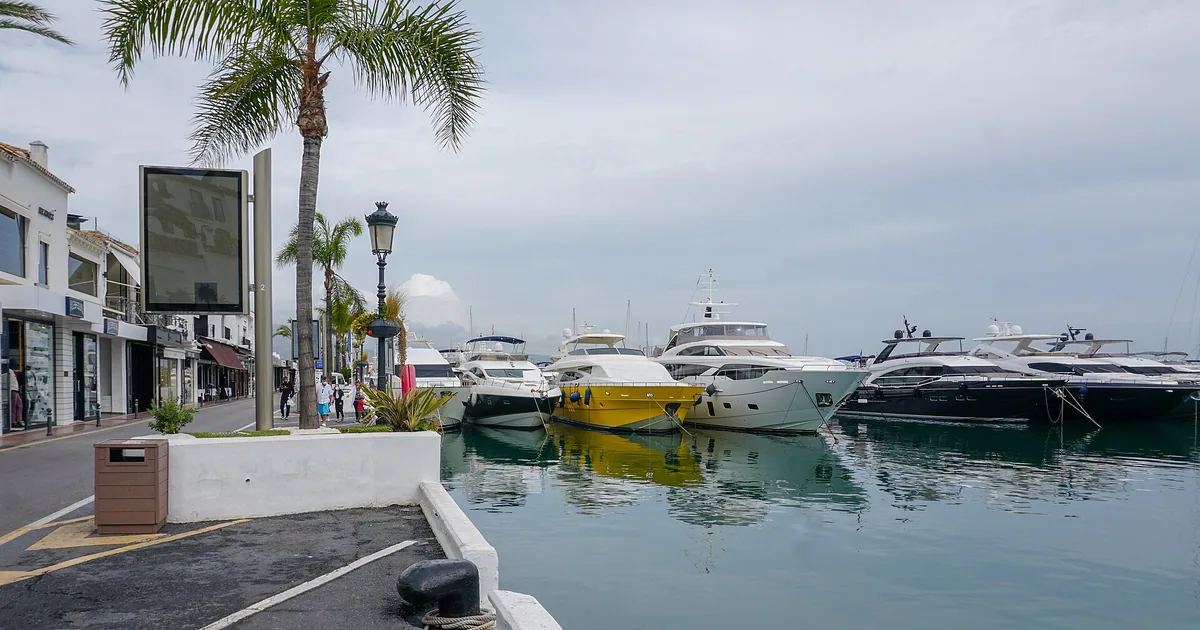
- Book a registered operator, the marina's own charter desk or a broker; Puerto Banús requires charter companies to be registered with the port
- Spain's Navigation Act writes the key clauses for you: compensation if the boat is late, a right to cancel after 48 hours of delay, and the skipper's final word on safety
- Since 1 October 2026 Spain has no licence-free self-drive rentals; to skipper yourself you need a recognised title such as an RYA Day Skipper
- Send every guest's name and passport number before the day, for the passenger list
- Pay the company named on the contract, by card or transfer, never a skipper's personal account, and get the balance date in writing
Most charter problems we see in Puerto Banús start before anyone reaches the pontoon: a boat booked through a stranger's Instagram account, a contract nobody read, a passport list sent at breakfast, a guest who assumed his licence covered a self-drive boat. This page is the booking process and nothing else. Our yacht charter guide covers what boats cost and where they go, and clients of our escort agency in Marbella usually read both before a day at sea. Book through a registered operator, the marina's own charter desk or a broker; get a written contract naming the boat, the hours and the cancellation terms; check the skipper's papers or your own licence; and send every guest's passport details before the day.
Should You Book Through a Broker, the Marina or the Operator?
For a day boat under 24 metres, book the operator directly or the marina's own charter desk, which rents yachts for two, four or eight hours. Use a broker for a yacht over 24 metres, a specific boat or several days. Whoever you choose, check they are registered with the port.
The Marina's Own Charter Desk
Puerto José Banús S.A., the company that runs the port, rents luxury yachts for two, four or eight hours, and sailing yachts and catamarans for one day or several, with or without a skipper. Requests go to customer service in the control tower, open 08:30 to 18:30 on weekdays and 08:30 to 14:00 and 16:00 to 18:30 at weekends. The advantage is the counterparty: you deal with the company that runs the port. It is the route we suggest to first-time charterers who have no broker and no operator they already trust.
Booking an Operator Directly
The port's coexistence rules for its 915 berths say that any company offering charters in Puerto Banús must be registered with the port and hold its authorisation. So the first question is simple: are you registered with the marina, and which pontoon do you sail from? A company that answers with a berth number has a base and a reputation to lose. One that offers to collect you from the quay, sends a different boat from the one in the photographs or will not put a contract in writing is one we would not put a client on, however good the price.
When a Broker Earns the Fee
Above 24 metres a yacht becomes a buque de recreo in Spanish law: limited to 12 passengers not counting crew, and outside every recreational licence, so it always comes with a professional captain. That is broker territory. A good broker knows which large yachts are actually free in August, has seen their charter paperwork, and drafts the contract, which matters more as the figure grows. For a three-hour trip on a 12-metre boat, a broker adds a layer you do not need. The largest yachts in the port are covered in our superyacht season guide.
What Spanish Law Writes Into Your Charter Contract
Spain's Navigation Act, Ley 14/2014, treats a charter as an arrendamiento náutico, with or without crew, and its rules are mandatory: compensation if the boat is late, a right to cancel after 48 hours of delay, compulsory liability insurance and the skipper's final word on safety. Everything else is whatever you sign.
The Clauses the Law Supplies
Articles 307 to 313 of the Navigation Act are short and worth knowing. If the boat is not handed over on the agreed date, the owner pays the compensation set in the contract or, failing that, an amount proportional to the delay; beyond 48 hours you may cancel or extend by the same time. The owner must keep compulsory civil liability insurance for the whole charter, and any claim expires one year after the charter ends. On a four-hour charter the 48-hour rule rarely bites, so ask what the contract says about a late or substitute boat.
The Clauses You Negotiate
Insist on a written contract or a detailed email confirmation, never a voice note. It should name the boat and its registration, the boarding and return times, the maximum number of guests, whether fuel is included, what water toys and drinks are aboard, and what happens if either side cancels. The weather clause matters most: who decides that conditions are unsafe, and whether you then get a refund or a new date. Ask too whether the price includes Spain's 21% VAT, because quotes are given both ways. How to spend the hours once you are aboard is the subject of our guide to planning the day on board.
The Skipper Has the Last Word
Article 310 settles the argument before it starts. On a crewed charter the skipper and crew follow your instructions on where to go and when, within what was agreed, unless those instructions put the boat or the people aboard at risk. Then the skipper's professional judgement prevails, and you and your guests are obliged to follow his orders. In practice that means a change of anchorage when the easterly Levante builds a chop off the Golden Mile, or an earlier return. We tell clients to accept it without debate.
Do You Need a Licence to Charter a Boat in Spain?
Not with a skipper, which is how most Puerto Banús charters run. To skipper yourself you need a title issued or recognised by Spain, and since 1 October 2026 that applies even to the smallest rental boats, which used to need no licence at all. Above 24 metres, professional crew is compulsory.
The 1 October 2026 Change
Royal Decree 1188/2025, published on 30 December 2025, rewrote the licence exemptions with effect from 1 October 2026. Motor boats up to 5 metres and 15 horsepower can still be used without a title, within two miles of where they set out and in daylight, but only for private use. Anyone renting one to drive now needs a licence, and the decree gives its reason in plain words: the high number of incidents and accidents in those rentals. Treat any offer of a licence-free rental as a sign the operator has not kept up.
Which Title Covers Which Boat
The limits below come from Royal Decree 875/2014 and its annex of recognised foreign titles. Miles are nautical miles from the coast, or from a harbour where stated.
| Title | Boat it covers | How far out | Typical holder |
|---|---|---|---|
| No title | Private use only, motor up to 5 m and 15 hp | 2 miles, daylight | Nobody renting, since 1 October 2026 |
| Licencia de navegación | Up to 6 m | 2 miles, daylight | Visitors after a short school course |
| PNB | Motor up to 8 m (sail with extra practicals) | 5 miles from a harbour | Spanish beginners |
| PER | Up to 15 m (24 m with extra practicals) | 12 miles | Most Spanish owners |
| RYA Day Skipper | Up to 24 m | 12 miles | British clients |
| RYA Yachtmaster Offshore | Up to 24 m | 150 miles | Experienced British skippers |
| Over 24 m | Recreational titles do not apply | Professional crew only | The yacht’s own captain |
Foreign Licences and the Annex IX List
A Spanish boat may be rented to anyone holding a valid title issued by their country of nationality or residence, provided that country is in the European Economic Area or appears in annex IX of the decree. Outside the EEA, the list covers Andorra, Argentina, Canada, Chile, Switzerland, the United Kingdom, Uruguay and Venezuela; RYA certificates are accepted within their own size and distance limits. United States boating cards are not on it, so American clients charter with a skipper. Bring the physical card, which Spanish rules require you to carry aboard; jet ski firms must even copy its details into the contract, as our jet ski guide explains.
How to Check the Boat Is Licensed for Charter
A Spanish boat chartered commercially is registered in the sixth list, the lista sexta, of the ship register. A private yacht in the seventh list may switch to charter use for up to three consecutive months a year, but only with express clearance, a charter company managing it and accident cover for everyone aboard.
Lista Sexta and Lista Séptima
Ask which list the boat is in; a professional operator answers at once. The temporary switch from private to commercial use is set out in article 9 of Royal Decree 186/2023, amended in December 2025: express clearance from the maritime authority, valid certificates, the inspections a sixth-list boat undergoes, and an accident policy covering death or injury of every person aboard on top of the compulsory liability insurance. During that period the owner, and anyone connected to him, may not serve aboard except professional crew permanently enrolled. Jet skis can never switch. Choosing the type of hull for the day is covered in our catamaran or motor yacht comparison.
Foreign-Flagged Yachts
Yachts registered outside Spain follow a stricter path. Under the same article 9, a recreational yacht flagged in another EU country or outside the EU needs express authorisation at its first clearance before working in charter in Spanish waters, proving it meets the requirements imposed on Spanish boats. For a client, the practical test is the same as for a Spanish boat: a written contract with a named company, proof of insurance, and a broker or operator who can show the authorisation if asked.
The Passenger List and the ID Requirement
Expect to send each guest's full name and passport or national ID number before the day, and to show the documents at the pontoon. The marina asks every visiting boat for a crew and passenger list, and operators keep the same list for the boat's papers and insurance.
What to Send and When
Names exactly as on the passport, the document number and nationality, sent the evening before at the latest. Boats arriving in Puerto Banús must give the control tower a crew and passenger list, with the registration papers, insurance and the captain's passport. A day charter leaving its home berth is simpler, but the operator still holds the list. Every operator we deal with asks for it, and a missing name at ten in the morning holds up everyone on the boat.
If a Companion Is Joining
She is a guest like any other and her details go on the same list. If you prefer, we send them straight to the operator, so the only thing said at the pontoon is good morning. Crews on this coast see every kind of guest list and care about the weather and the schedule. The arrival order we suggest, and what to send us and when, is set out in our step-by-step booking post.
Deposits, Payment and the Paper Trail
Most operators take a deposit when you book and the balance before boarding. Pay the company named on the contract, by card or transfer, never a skipper's personal account, and keep every receipt. A companion joining the day is a separate booking, with its own 25 per cent deposit by transfer or crypto, to her or to us.
Reading the Deposit Terms
Three questions cover it: what share is due now, when the balance falls due, and how the deposit comes back if the skipper cancels for weather. Charter operators set their own terms, so read them before transferring anything. Pay the company named on the contract, never a skipper's personal account, and get the balance date in writing; a deposit with no named recipient is the commonest charter dispute we hear about. Our deposit policies post applies the same logic to a companion booking.
Card or Transfer, With a Receipt
A card payment or a bank transfer to the company named on the contract leaves a trail that matches the paperwork: the name on the receipt is the name on the contract, and the receipt doubles as proof of what you agreed. A transfer to a skipper's private account or a gift card does not, and an operator who asks for one has told you something. Keep the receipts until the boat is back and the deposit has been released.
Adding a Companion to the Charter
Book the boat first, then send us the boat's name, the pontoon, the boarding time and the return. Her time is €300 an hour, so a five-hour afternoon at sea is €1,500, weekends included; the boat is paid to the operator. We pass her details to the operator for the passenger list.
What We Need From You
The marina and pontoon, the boat's name, the skipper's number if you have it, the boarding and return times, and whether dinner follows. Puerto Banús is large: the boats moor along the Muelle de Ribera, the Muelle de Benabolá and the Levante breakwater, and a berth number saves a long walk in July heat. For the general sequence of a booking, see how booking a Marbella escort works; for the port itself, our Puerto Banús escorts page shows who is available.
Choosing Who Joins You
A day at sea is a different request from a dinner date: sun, swimming and five or six hours with the same small group. Our yacht companions are grouped separately for that reason. A yacht day booked in advance takes a 25 per cent deposit by transfer or crypto, to her or to us, and you pay her the balance at the start, in cash or by transfer. Changes are free until 72 hours before a yacht day, and a boat cancelled by the skipper is never charged, as our cancellation guide sets out.
Frequently Asked Questions
Can I rent a boat without a licence in Spain?
Not since 1 October 2026. The exemption for motor boats up to 5 metres and 15 horsepower now covers private use only, so anyone renting a boat to drive it must hold a recognised title. With a professional skipper aboard, which is how most Puerto Banús charters run, you need no licence at all.
Is a British RYA licence valid in Spain?
Yes, for boats up to 24 metres within the certificate's limits. Spain's list of recognised foreign titles gives Day Skipper 12 miles from the coast, Coastal Skipper 20 miles, Yachtmaster Offshore 150 miles and Yachtmaster Ocean no limit. Powerboat Level 2 covers motor boats up to 10 metres within 5 miles.
What happens if the charter boat is late?
Spain's Navigation Act makes the owner pay the compensation agreed in the contract or, failing that, an amount proportional to the delay. If the delay exceeds 48 hours, you may cancel or extend the charter by the same time. These rules are mandatory and cannot be signed away in the contract.
How do I pay for a yacht charter in Puerto Banús?
Most operators take a deposit by card or transfer when you book and the balance before boarding. Pay the company named on the contract, never a skipper's personal account, and keep the receipt, which doubles as proof of what you agreed. A companion joining the day is paid separately: a 25 per cent deposit by transfer or crypto, then the balance to her.
Who decides where the boat goes?
You do, within the contract. The skipper follows your instructions on where to go and when, unless they put the boat or the guests at risk; then his professional judgement prevails and everyone aboard must follow his orders. That rule is article 310 of Spain's Navigation Act.
Booking a Charter With Company?
Send us the boat's name, the marina and pontoon, the boarding and return times and how many guests are aboard. We confirm a companion suited to a day at sea, the price for the hours you want, and pass her details to the operator for the passenger list.
Book on WhatsApp