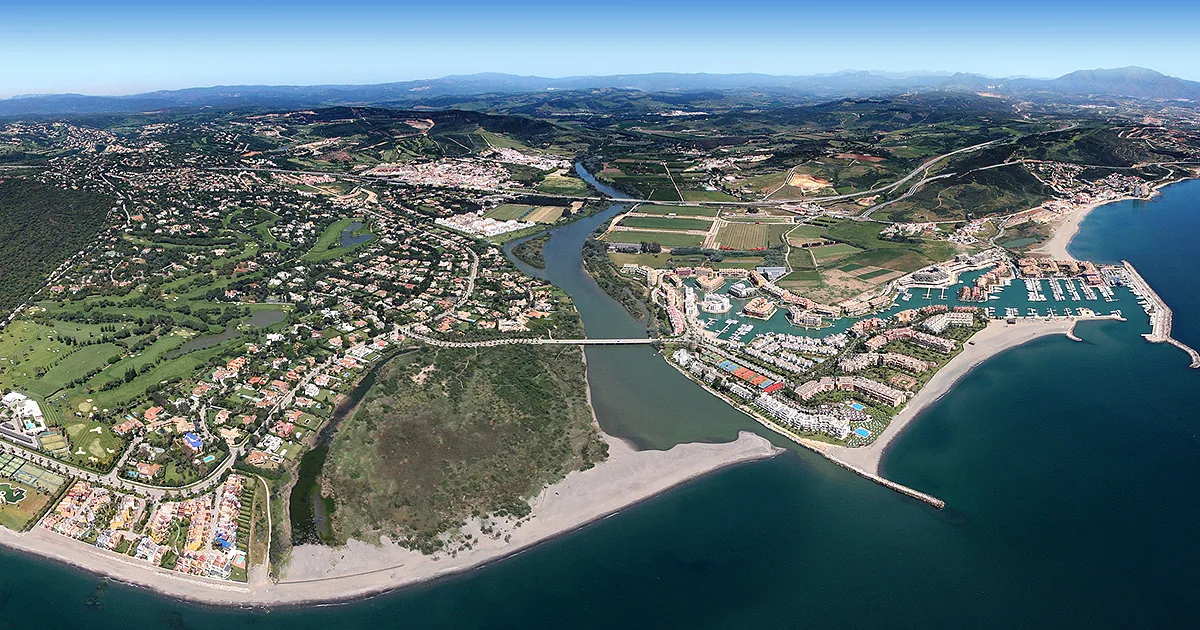
- Sotogrande's polo year runs from Easter to mid-October, peaking with the International Tournament, whose 55th edition ran from 27 July to 29 August 2026.
- It is three back-to-back cups, Bronze, Silver and Gold, each at low, medium and high goal.
- Ayala Polo Club has run it since 2021, on its own fields and the Los Pinos fields, long Santa María Polo Club's main ground.
- Spring (from 26 May in 2026) and autumn (to 18 October) bring smaller cups and uncrowded afternoons.
- It is about 45 minutes from Marbella; companion bookings there carry the two-hour minimum for outside Marbella.
Ask most people on this coast about polo and they mean one week: the Gold Cup at the end of August, the busiest social date of the Sotogrande summer. The season is a good deal longer than that, and some of the best afternoons come in June and October, when there is plenty of room at the boards and you can hear the horses. As a Marbella escort agency that plans a fair number of polo days for clients, we keep a calendar, and this is it. Polo in Sotogrande runs from Easter to mid-October: Ayala Polo Club's spring cups from late May, the International Tournament from late July to the end of August (Bronze, then Silver, then Gold Cup), and autumn cups until the third week of October.
For bookings on the estate itself, see our Sotogrande escorts page. This guide is the calendar, plus the logistics of a final day.
When Is Polo Season in Sotogrande?
From Easter to mid-October. A few cups around Easter, Ayala Polo Club's spring season from late May to mid-July, the International Tournament from late July to the end of August, then autumn cups until mid-October. Winter is quiet: the Spanish federation listed no tournaments at all between mid-November 2025 and late March 2026.
The Calendar at a Glance
| Month | Tournament / level (2026) | What to expect |
|---|---|---|
| January – March | No federation tournaments listed in 2026 before late March | Off season; nothing to plan a trip around |
| April | Easter cups, such as the Memorial José Ignacio Domecq (played in Sotogrande in 2025) | The first matches of the year, small crowds |
| Late May – June | Ayala spring season: Copa Bienvenida (26 – 31 May 2026), Copa Joseph McMicking (4 – 14 June) | Club polo, room at the boards |
| Early July | Memorial Enrique Zóbel and Memorial Manuel Prado y Colón de Carvajal (2 – 12 July) | The last cups before the summer teams arrive |
| 27 July – 1 August | International Tournament: Bronze Cup, low, medium and high goal | The warm-up week; the crowds start |
| 3 – 15 August | Silver Cup, low, medium and high goal | Busy; the finals draw the first big social day |
| 17 – 29 August | Gold Cup, low, medium and 22-goal high goal | The peak: the best polo and the biggest crowds |
| September | Copa San Enrique de Guadiaro (3 – 6), Copa Despedida (10 – 13) | Warm evenings, quieter roads |
| October | Copa Otoño I (8 – 11) and II (15 – 18) | The season’s last matches |
| November | Iberian Polo Tour dates, venues to be confirmed | Check before you travel |
Low, Medium and High Goal
Every player carries a handicap from −2 to 10 goals, a measure of worth to the team rather than of goals scored, and fewer than two dozen players in the world hold 10. A team's level is the sum of its four players. Sotogrande's summer tournament plays every cup at three levels: low goal (6–8 goals in 2023), medium (12–14) and high goal, which the organisers raised to 22 goals in 2023 and kept there in 2024. High goal is where the Argentine professionals play: in 2024 the field included seven of the eight players from the most recent Argentine Open final. Low goal mostly plays in the morning.
The International Tournament: Bronze, Silver and Gold
Sotogrande's International Polo Tournament is a summer-long competition of three consecutive cups, first played in 1971 with the inaugural Copa de Oro. Its 55th edition ran in 2026: Bronze from 27 July to 1 August, Silver from 3 to 15 August and Gold from 17 to 29 August, each at low, medium and high goal.
How the Three Cups Work
The Bronze Cup is the warm-up, a week in which teams settle their horses; the Silver takes the first half of August; the Gold is the one people mean when they say the Sotogrande polo. Each cup has its own low, medium and high-goal competitions, which explains the scale: by Ayala's own count the 2023 edition scheduled 124 matches in 34 days for 25 teams, and in 2024 it counted more than 20 teams from several countries, a thousand horses and seven weeks of play. The tournament has been cancelled only once, in 1989, during an outbreak of African horse sickness. Each cup's dates appear on the Spanish polo federation's calendar.
Ayala, Los Pinos and La Capilla
Older guides call this Santa María Polo Club's tournament. Since 2021 it has been organised by Ayala Polo Club, the Zóbel family's club at San Enrique de Guadiaro, with three professional fields and 400 stables, and matches are split between Ayala's grounds and the Los Pinos fields, built between 2002 and 2008 as Santa María's main venue. Both sit off exit 133 of the A-7. Polo here goes back to the mid-1960s, when Enrique Zóbel laid out the first field, La Playa, by the sea; a storm destroyed it in 1984. A third club, La Capilla, runs its own August series, the Emerald, Sapphire, Ruby and Diamond Cups.
Spring and Autumn: Polo Without the Crowds
Outside August the polo is good and the crowd is small. Ayala's 2026 spring season ran from the Copa Bienvenida (26 to 31 May) through the Copa Joseph McMicking in June to two memorial cups in early July, and its 2026 autumn calendar runs from early September to 18 October. Same sport, a fraction of the August crowd.
Easter to Mid-July
Easter brings the first cups of the year: in 2025 the Memorial José Ignacio Domecq, an Iberian Polo Tour fixture, was played in Sotogrande from 4 to 6 April. Ayala's spring season proper starts in late May. In 2024 it opened on 29 May, and Los Schatzies, the team led by the German player Jella Herzer, won the Copa Bienvenida, the Copa Joseph McMicking and the twelve-team Open de España, whose final at Los Pinos drew a large crowd. In 2026 the federation listed the Copa Bienvenida for 26–31 May, the McMicking for 4–14 June and the memorials to Enrique Zóbel and Manuel Prado y Colón de Carvajal for 2–12 July.
September to Mid-October
In 2026 Ayala listed the Copa San Enrique de Guadiaro (3–6 September), the Copa Despedida (10–13 September) and two autumn cups, Otoño I and II, on 8–11 and 15–18 October. September and October are the months we suggest to clients who want the polo rather than the social scene: the evenings are still warm, and from 1 October the AP-7 toll drops back to its normal-season rate. After mid-October the calendar thins out to the Iberian Polo Tour's November dates, venues still unconfirmed when we checked, and then nothing until spring. Our 2026 events calendar shows what else is on along the coast in those months.
Final Day: How to Do the Gold Cup Properly
Arrive early, know the match times and plan the evening before the afternoon. High-goal matches usually start between 17:00 and 19:00, and the Gold Cup ran until 29 August in 2026. General entry has been free in Ayala's editions, and hospitality is sold as VIP daily passes through the club.
Times, Entry and Parking
Low-goal matches are mostly played around 10:00 and 11:30; the high-goal games and finals take the evening slots, when the heat drops. In 2024 the Bronze Cup high-goal final started at 19:00, and the Gold Cup final fell on Saturday 31 August, followed by a free concert. Under Santa María, general admission cost €7 in 2019, with the Silver and Gold finals priced separately; Ayala has let spectators in free (it said so for 2023) and sells VIP daily passes for its hospitality areas. Arrive an hour before the match you care about: finals evenings are the busiest social dates of the summer.
Last Chukker and the Evening
After the last match the crowd moves to Last Chukker, the after-polo area at Los Pinos that Ayala relaunched under that name in 2023, with food stands, a bar and live music. In 2024 it staged four free concerts between 27 July and 31 August on field three, sponsored by Larios, with reserved tables for sale. Most of our clients then either dine in Sotogrande and drive back late, or have a drink at Last Chukker and dine in Marbella from 22:30. Our guide to Sotogrande itself covers the marina and the estate.
Dress and Etiquette, Briefly
Smart-casual, country rather than beach club: linen trousers or chinos and a shirt, a jacket in hospitality; a summer dress or trousers for her, with flat or block heels, because at half-time everyone walks onto the grass to tread in the divots. A match lasts up to two hours, much of it in low, strong sun, so bring a hat and water. That is the short version; our polo etiquette guide covers the rest.
Getting to Sotogrande From Marbella
Drive or book a driver. The polo grounds sit off exit 133 of the A-7, about 50 km and 40 to 45 minutes from central Marbella. Between June and September the AP-7 toll costs a car up to €10.30 each way, against €6.30 the rest of the year.
Tolls and Roads
Autopista del Sol's 2026 tariffs put the San Pedro main toll plaza at €6.25 for a car in the special season (June to September, plus Easter) and the Manilva plaza on the Estepona–Guadiaro stretch at €4.05, hence the €10.30. From October the same plazas cost €3.85 and €2.45. The free A-7 runs through Estepona's roundabouts, a slow way home on an August evening. A 19:00 final ends around 21:00 and the after-polo starts at once, so settle who drives back before you leave. Full tariffs are on the Autopista del Sol website.
Driver, Taxi or Bus
A car with a driver who waits is what we arrange for most polo days, because it solves parking, drinking and the late return at once. A taxi works for one leg: at the Junta's 2026 interurban tariff (€0.71 a kilometre by day, €0.82 at night and at weekends, counted as a round trip) the run costs roughly €70–€90 each way, and the return must be booked in advance. Avanza's coast buses stop at the Guadiaro junction on the N-340 (€6.55 from Marbella in 2026), but a bus stop on the main road is not where you want to be after a final. For hire cars, see our car rental guide.
Overnight in Sotogrande or Drive Back?
Drive back if your evening is dinner in Marbella; stay if the polo is the whole point or the final runs late. SO/ Sotogrande, a five-star resort on Avenida Almenara, is the obvious base on the estate, and Finca Cortesín in Casares sits between Estepona and Sotogrande. Book either well ahead for August.
The Drive-Back Evening
The drive-back plan suits most clients: polo from 17:00, a drink at Last Chukker, then 45 minutes back for a 22:30 dinner on the Golden Mile or in the old town. It keeps the late part of the evening in a town that is still busy at midnight, which Sotogrande, by design, is not. The cost is the drive itself, and with a driver that disappears. If you are attending several days of the Gold Cup, Marbella as a base with Sotogrande as a commute works perfectly well, and it leaves your evenings free for Marbella's restaurants and late bars.
Staying Over
Staying makes sense for a final, for a run of match days, or when the polo is the reason for the trip. SO/ Sotogrande Spa & Golf Resort is 25 km from Gibraltar airport and 109 km from Málaga's, with rooms, studios and penthouse apartments; Finca Cortesín, in Casares, is the quieter alternative. Marina apartments and villas on the estate are the other option, and they suit a longer booking better than a hotel corridor does. Our overnight format runs ten to twelve hours, which covers a final, dinner and breakfast without anyone watching the clock.
Booking a Companion for a Polo Day
Sotogrande is outside Marbella, so the minimum is two hours at €300 an hour, and the client pays her taxi for the drive. For a final day we suggest an event booking that covers the match and dinner, priced by the hour, or an overnight if you are staying on the estate.
Two-Hour Minimum, Briefed Like an Event
For context, a Marbella dinner date is a minimum of three hours, so from €900, and an overnight is €3,000–€4,000 depending on the companion and the length; a Sotogrande polo day uses the same rates with the two-hour minimum, the same in July and August as in any other month, and the client pays her taxi. Tell us the date, the cup and level, any hospitality passes, who else is in your party, and if you plan to drive back or stay. Allow at least a week for a Gold Cup weekend: a booking made in advance carries a 25% deposit by transfer or crypto, to her or to us, and you pay her the balance at the start. Our events guide explains how we brief.
Who Suits a Polo Afternoon
A polo afternoon is three hours of conversation with breaks for sport, so the right companion is at ease among strangers and will talk to your host as readily as to you. Our event companions are chosen for exactly that. The tournament draws an international crowd, and a British companion such as Amber, Kimberly or Lara is at home in it, while a Spanish speaker helps with staff and the Argentine teams. Whoever you choose will dress for grass and sun rather than a beach club, and will know when the divot stomp starts.
Frequently Asked Questions
When does the polo season start in Sotogrande?
The first cups come around Easter, Ayala Polo Club's spring season starts in late May (26 May in 2026) and the International Tournament begins in the last week of July. Matches continue until mid-October, so Sotogrande has polo for roughly half the year, peaking in August.
When is the Gold Cup final in Sotogrande?
The Gold Cup closes the International Tournament at the end of August. In 2026 the federation calendar listed it from 17 to 29 August, and in 2024 the final was played on Saturday 31 August. The high-goal final is normally an evening match, so plan the whole afternoon and evening around it.
Is it free to watch polo in Sotogrande?
General entry to the International Tournament has been free in the editions run by Ayala Polo Club, which sells VIP daily passes for its hospitality areas. In 2019, under Santa María Polo Club, general admission cost €7. You pay for food and drink, and for the after-polo's reserved tables if you want one.
How do I get to the Sotogrande polo from Marbella?
Drive west on the AP-7 or the A-7 to exit 133, about 50 km and 40 to 45 minutes from central Marbella. The toll road costs a car up to €10.30 each way in summer. A car with a driver solves parking and the late drive home after a final.
Who organises the Sotogrande International Polo Tournament?
Ayala Polo Club, the Zóbel family's club at San Enrique de Guadiaro, has organised it since 2021. Matches are played on Ayala's three fields and on the Los Pinos fields, long Santa María Polo Club's main venue. The 2026 edition was the 55th since the first Copa de Oro in 1971.
Planning a Day at the Polo?
Send us the date, the cup you are watching and your plan for the night: back to Marbella or a stay in Sotogrande. We will confirm who is free, give you the price of the day and her taxi fare, and agree a pick-up time that gets you to the boards before the first chukka.
Book on WhatsApp